Stringing Report App

Turn pipeline field records into reusable, structured reports

ReactField OperationsWorkflow DesignStructured Export
Role
Independent client application developer through TimCis Media
Context
Pipeline construction crews recording joints and fittings for stringing reports
Implemented
Reusable report tables, structured field entry, row duplication, editing, and spreadsheet export
Constraint
Reflect the field workflow in a simple interface suitable for on-site use
Outcome
Replaced repeated paper entry with reusable digital tables and exportable records
Status
Completed professional project retained as an evidence-backed public demonstration

I built the Stringing Report App through TimCis Media as part of my professional pipeline-support work. The job was not to make a generic table editor; it was to understand how field crews record joints and fittings, preserve the vocabulary they already use, and reduce repeated paper entry.

The application keeps each report focused on the fields needed on the job: joint or fitting number, size, length, wall, grade, heat number, purchase order, and comments. Crews can edit rows, copy the preceding row when specifications repeat, keep multiple tables, and export the result for the next part of the reporting process.

The walkthrough uses fictional representative values created specifically for this portfolio. It contains no client records.

01

A field record shaped around the actual work

The populated table shows the operational model directly: sequential joints, repeated pipe specifications, traceable heat and purchase-order fields, and location-specific comments. Copy Last Row accelerates the common case without hiding differences, while editing and spreadsheet export keep the record useful after field entry.
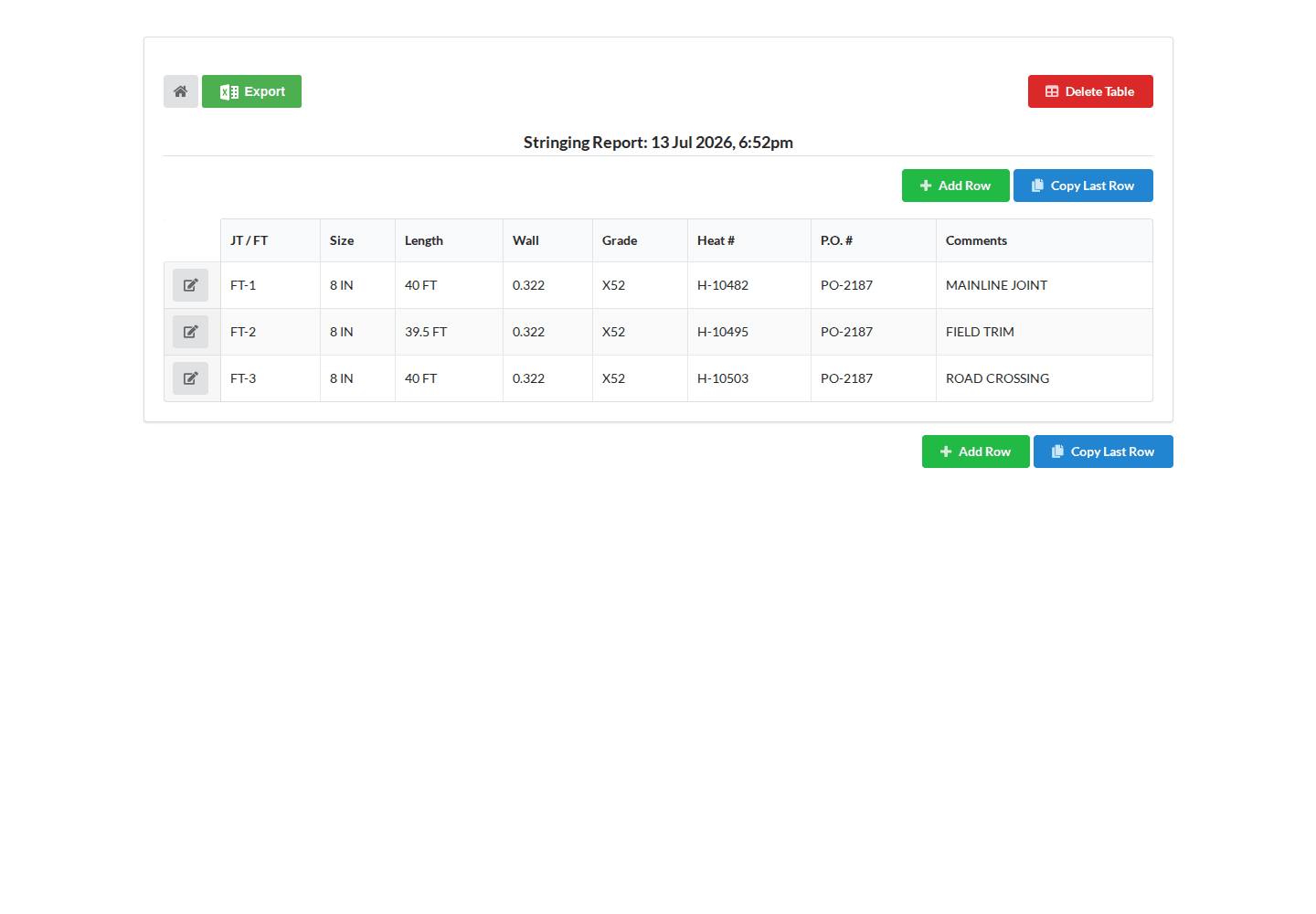
Stringing Report App showing three fictional pipeline joint records in a structured field table

Domain learning was part of the implementation

This project sits alongside my CAD-derived 2D isometric work for pipeline operations. Understanding the records, terminology, and handoff mattered as much as writing the interface. That connection between operating procedure and implementation is also the thread through my enterprise workflow and internal-tool work.

The public application and repository show the delivered interaction model. The screenshot uses newly entered fictional values so the evidence remains reviewable without presenting client data as portfolio content.

  • src/componentsContains the report-table, entry, editing, and supporting interface components.
  • README.mdDocuments the field workflow, project status, and historical technology context.
  • React components model report tables and editable joint or fitting rows; browser persistence keeps working records available between page visits.
  • The interface supports repeated-row entry and spreadsheet export because those actions match the surrounding field and reporting workflow rather than a generic CRUD checklist.
  • The interface reflects the period in which it was delivered. The public repository now uses Vite and React 18, replaces its unmaintained export wrapper with a small browser-native export path, passes a high-severity dependency audit, and retains the original workflow without presenting a redesign as new client work.

Like what you see? I'm available for full-stack and automation work.

Get in touch