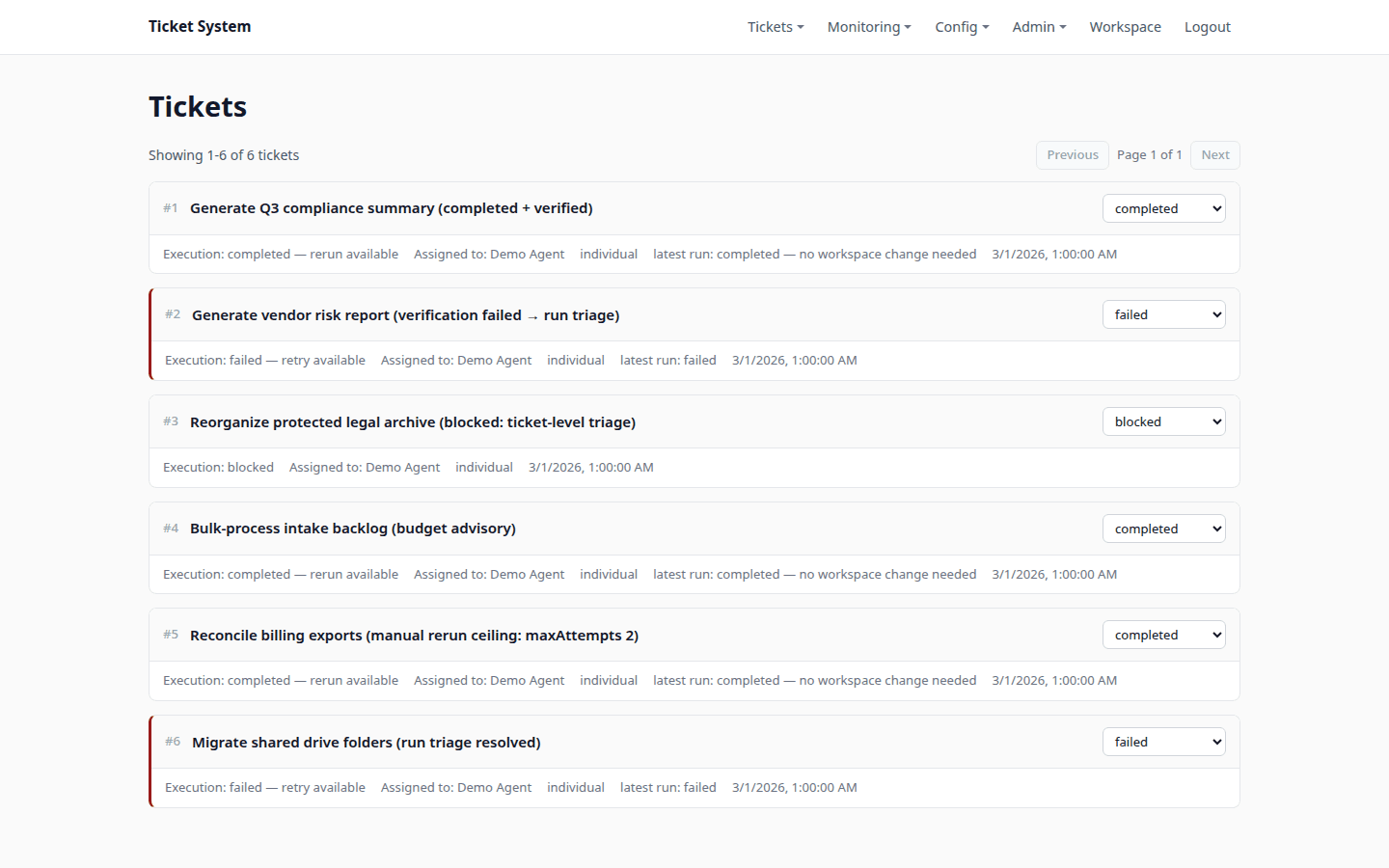
The interesting part isn’t that the system runs agent work; it’s that it treats every failure as material to improve from. Agent runs execute against realistic business fixtures — vendor compliance, legal intake, customer support, and shared-drive cleanup — and a verifier scores each result against an explicit contract. A wrong answer isn’t discarded. It becomes a case.
From there the repo runs a loop. A failure-classification workflow sorts each failure into a frozen S1–S5 taxonomy, and recurring cases are grouped by root cause in a failure-cluster report. The classifier itself is agent work: it builds a dossier per failed run, drafts a classification on a cheap model tier, and escalates to a stronger one only when confidence is low — the same governed execution the rest of the system uses, pointed at itself.
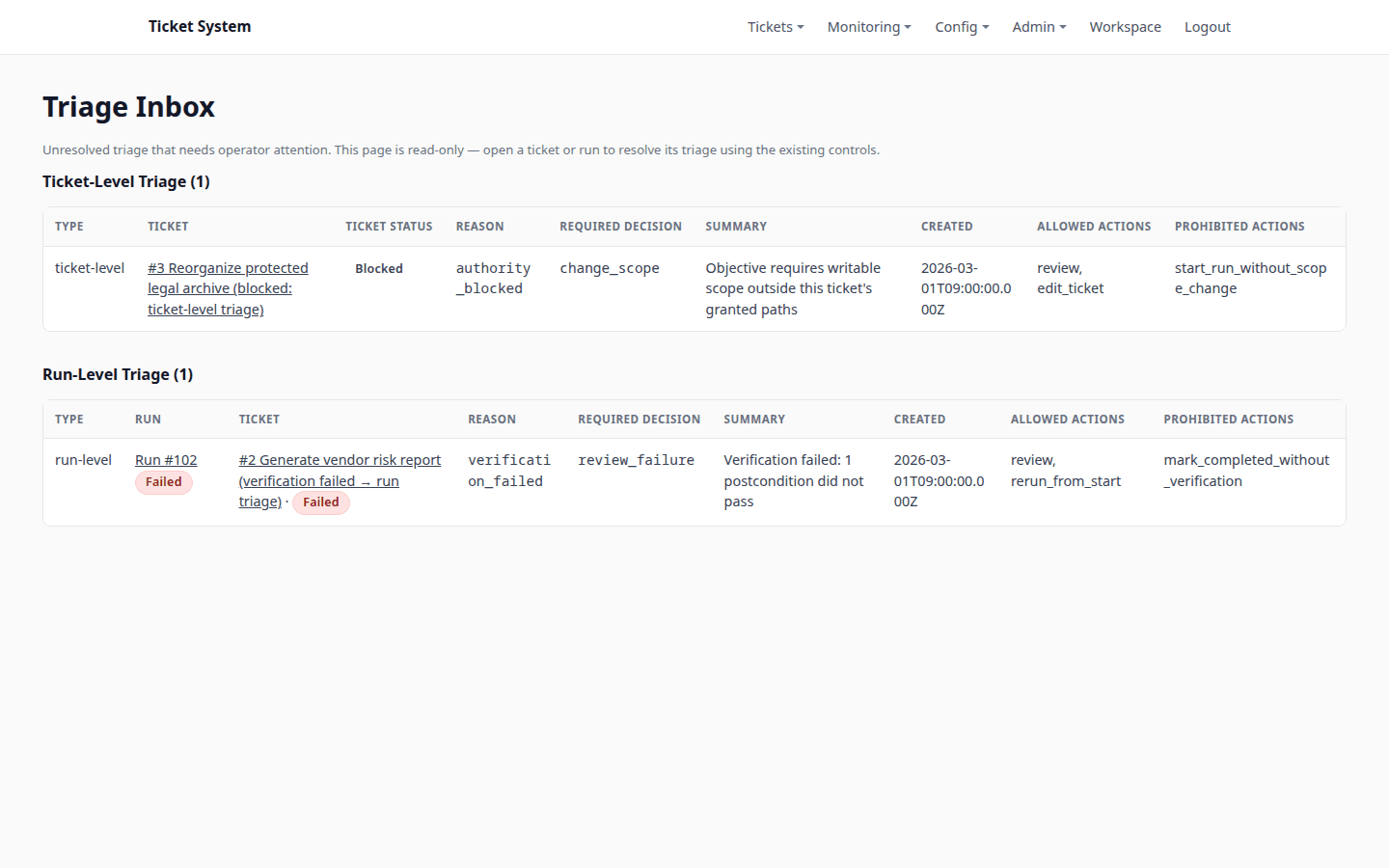
None of this needs a human at the console. Every action in the web UI has a headless equivalent in oquery, a CLI an agent drives under the same authority and evidence rules: create a ticket and wait for its run as JSON, inspect a timeline, replay a run, resolve triage, even operate the bounded workspace. It’s the seam that lets the system act on itself — the failure classifier files its own tickets through this very interface.
When a fix is proven by direct causal evidence, it graduates through a documented promotion process — observation, analysis, experiment, validated improvement, candidate principle, invariant — and a regression test locks it in so the same failure can’t return. The architecture invariants even forbid the tempting shortcut: don’t widen a limit or special-case the runtime to make a benchmark pass. Improve the guidance instead.
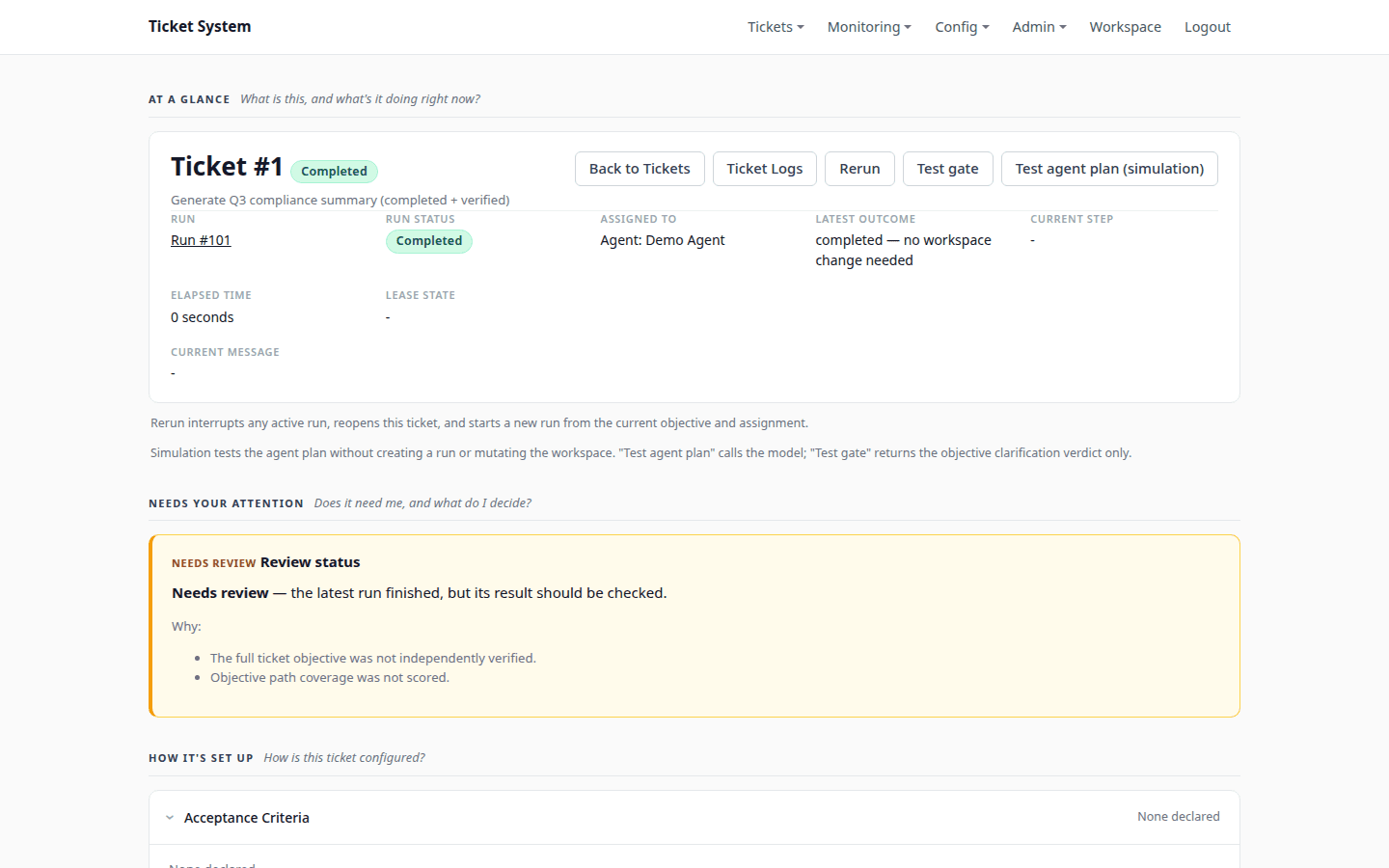
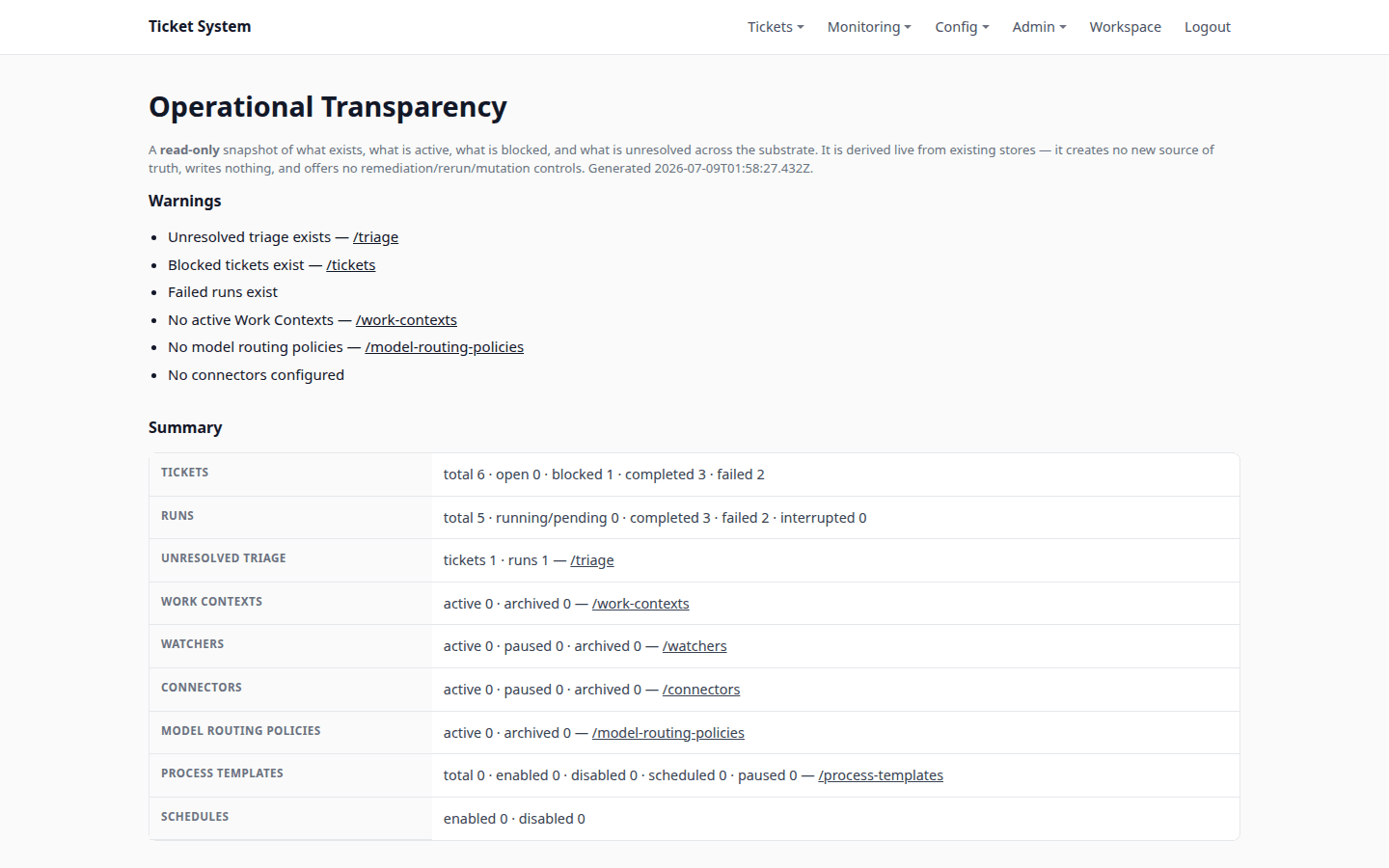
The whole thing leaves receipts, and the receipts are built to be trusted rather than just kept. The append-only event log is the source of truth; the tickets and runs you see are projections rebuilt from it, and an integrity audit proves the derived state still matches. Replay goes beyond reproduce — a tamper test corrupts snapshots ten ways and asserts the verifier catches every one, so history can’t be quietly rewritten and still pass.
Collaboration is held to the same standard. A handoff between agents isn’t a private channel or a chat transcript; it’s an ordinary ticket transition with receipts, so whoever picks up the work inherits the full trail. Agent-produced changes don’t merge on trust either — a verification gate runs build, workflow, postcondition, endurance, and regression checks before one is accepted.
The result reads less like source and more like an operated system’s logbook — the reasoning behind each principle written down next to the evidence that earned it.